Financial Health and Mental Health: Perhaps They Are More Connected Than We Think
Over the years working as a financial planner, having the opportunity to hold many conversation around the topic of money with employees and clients from different background, one thing I have increasingly come to realise is that financial planning is rarely just about the money.
Of course, the money and numbers are still important.
When someone comes to see a financial planner, we naturally look at their income, expenses, savings, debt, insurance, investments, retirement planning and many other aspects of their financial life. These numbers give us useful information about someone's financial health, the risks they may be facing and whether they are making sufficient progress towards the future they want.
But I have also met people whose financial numbers seem to be doing reasonably well, yet they don't necessarily feel that way.
Someone may have accumulated a significant amount of savings and still constantly worry about whether it is enough.
Someone may be saving 30% of their income every month, have little debt and be well prepared for retirement, yet spending money on themselves still creates guilt.
At the same time, someone earning a very good income may constantly feel that they are falling behind because the people around them seem to have bigger houses, nicer cars or more expensive holidays.
This makes me wonder:
When we say someone is financially healthy, are the numbers enough to tell us?
WHAT WE CAN SEE, AND WHAT WE MAY NOT SEE
Most of the things we traditionally look at in financial planning can be measured.
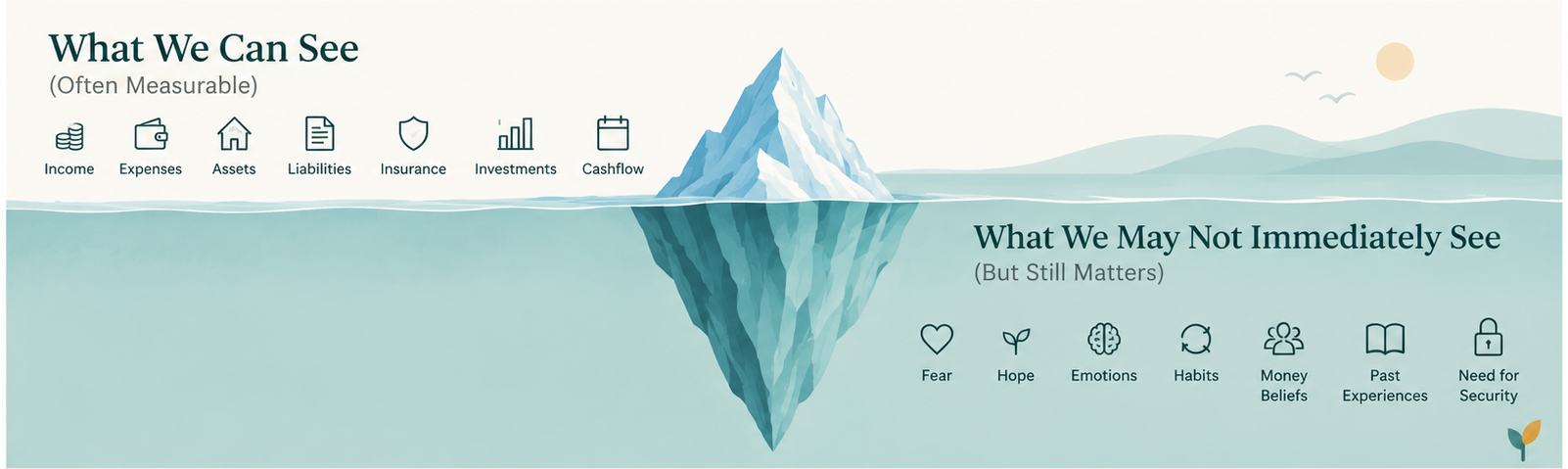
Income. Expenses. Assets. Liabilities. Insurance. Investments. EPF. Retirement projections. Cashflow.
I sometimes think of these as the part of an iceberg that sits above the water. They are the things we can see, measure and put into a financial plan.
And they are important. I am certainly not suggesting that we should stop looking at them.
But underneath the water, there may be another part of someone's financial life that is much harder to see.
Fear.
Hope.
Emotions.
Habits.
Our experiences growing up with money.
The beliefs we have developed about what money means.
Our need for security.
The expectations we carry from our family or society.
The things we are afraid might happen in the future.
These may not appear anywhere in a financial statement, but they can have a significant influence on how we experience and manage our money.
Two people can have very similar financial circumstances and still feel completely differently about them.
This is where I think financial health starts to become closely connected with our mental and emotional wellbeing.
HAVING MONEY AND FEELING FINANCIALLY SAFE MAY NOT BE THE SAME THING
Having sufficient money and feeling financially safe may not always be the same thing.
Imagine someone who has spent many years being very careful with money.
They save consistently, have little debt, have built up a healthy investment portfolio and, based on the retirement projection, should have enough to support a reasonable retirement.
From a financial planning perspective, many of the numbers look healthy.
But this person still worries.
Every major purchase requires a lot of consideration. Taking a family holiday creates guilt. When the investment market falls, they become extremely anxious. Even after retirement, they continue to hesitate about spending because they are worried that the money may eventually run out.
Would we consider this person financially healthy?
From one perspective, yes.
Perhaps this person is actually in a much stronger financial position than many other people.
But I think there is another question worth asking.
Does this person feel financially safe?
Having sufficient money and feeling financially safe may not always be the same thing.
I think this distinction matters because ultimately, the purpose of building financial resources is not simply to accumulate the largest possible number.
The money is there to support our life.
If someone spends decades building financial security but continues to live with constant fear of not having enough, perhaps there is something about financial health that the numbers alone are not capturing.
WHAT IS HAPPENING IN OUR LIFE CAN ALSO SHOW UP IN OUR MONEY
The relationship can also work in the other direction.
Sometimes what appears to be a financial problem may have something else happening underneath it.
Someone may come to me and say:
“I think my problem is that I overspend.”
The natural response is to look at the budget.
How much are you spending? Where is the money going? What can we reduce?
These are reasonable and useful questions.
But perhaps there is another question worth exploring as well: “What is the spending doing for you?”
A question to think about
Think about something you spent money on recently that you didn't really plan for.
Instead of asking only, “Why did I spend so much?”, try asking:
“What was I hoping this spending would give me?”
For some people, spending may be a way to reward themselves after working very hard.
For someone else, buying something may provide a temporary sense of comfort during a stressful period.
Some people spend on their children because they don't want them to experience the things they themselves lacked growing up.
Some may feel pressure to maintain a certain lifestyle because everyone around them seems to be doing the same.
And sometimes, spending is simply one of the few things that gives us a sense of enjoyment when everything else in life feels difficult.
This does not mean that every spending decision needs to have a deeper psychological explanation.
Sometimes we overspend simply because we didn't plan properly, or because we saw something we wanted and bought it.
But I think it is worthwhile to recognise that our financial behaviours don't exist separately from the person making those decisions.
Our emotions, experiences, beliefs, relationships and circumstances can influence the way we use money.
And the way we use money can, in return, affect how we feel.
“HOW MUCH IS ENOUGH?” MAY NOT ONLY BE A MATHEMATICAL QUESTION
I see something similar when we talk about retirement.
One of the most common questions people want a financial planner to answer is:
“How much do I need to retire?”
Naturally, we can calculate this.
We can estimate future expenses, inflation, investment returns, life expectancy and many other assumptions, and eventually arrive at a number.
This calculation is useful because we need some idea of whether the financial resources we are building are likely to support the retirement we want.
But what happens when the numbers suggest that someone is reasonably well prepared, and the person still doesn't feel comfortable?
Do we calculate again?
Would another RM500,000 make the worry disappear?
Would RM1 million?
Perhaps.
But at some point, I think “How much is enough?” may become more than just a mathematical question.
What would make me feel safe?
What am I afraid might happen?
What kind of life am I actually trying to protect?
What would having enough allow me to do differently?
These questions are much harder to put into a financial calculator.
Yet I think they matter because ultimately, financial planning is not about creating the perfect spreadsheet.
It is about helping someone use their financial resources to support a life that matters to them.
PERHAPS FINANCIAL HEALTH IS PART OF OUR OVERALL WELLBEING
I am not suggesting that financial planners should become mental health professionals. We shouldn't.
There are areas of mental health that require the knowledge and support of appropriately trained mental health professionals, just as there are financial matters that require appropriate financial expertise.
But perhaps we also shouldn't treat financial health and mental health as if they exist in two completely separate rooms.
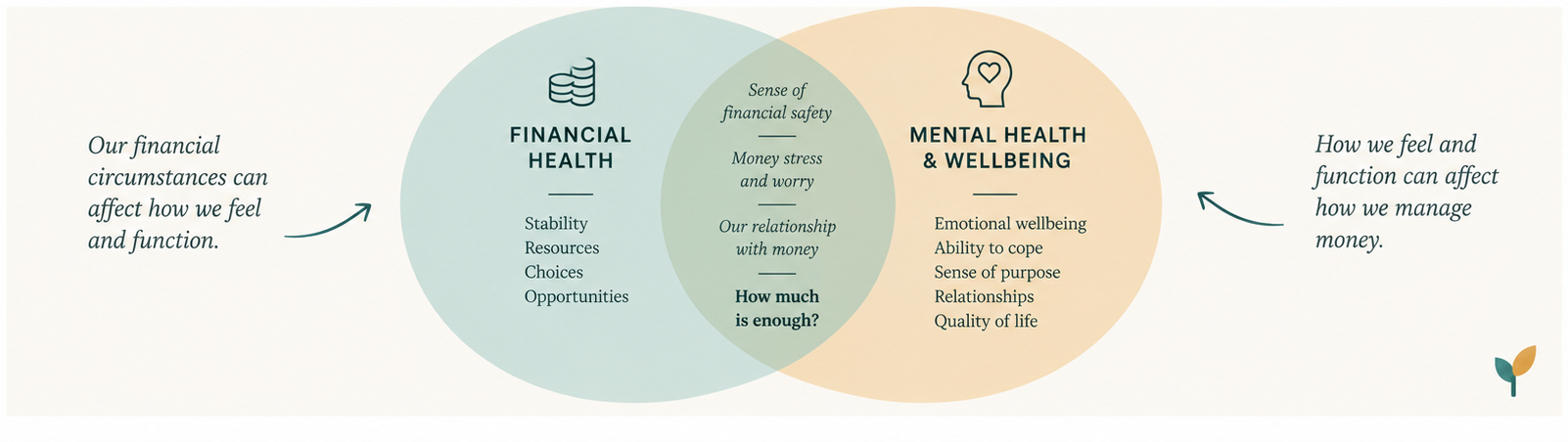
Money affects many parts of our lives.
It affects the choices available to us, our sense of security, our relationships, our ability to deal with unexpected events and, sometimes, the way we see ourselves and our future.
At the same time, what is happening in our lives can affect the way we make financial decisions.
This is why I have increasingly come to see financial planning as something that needs to begin with the person, before we move into the numbers.
Because the numbers belong to someone.
Someone with worries, hopes, responsibilities, values, experiences and a life they are trying to live.
Perhaps good financial health is not simply about having more money.
It is about having sufficient financial resources to support the life that matters to us, having enough resilience to deal with what life may bring, and hopefully reaching a point where money creates less worry and gives us more freedom to focus on living.
And somewhere between financial health and mental health sits a deceptively simple question:
How much is enough?
I don't think the answer will always be found in a spreadsheet.
About Kevin
Kevin Neoh is a Licensed Financial Planner and Certified Financial Coach who believes that good financial planning starts with understanding the person before the numbers. His work focuses on helping people improve their financial health, reduce money stress and use money to support the life that matters to them.
If you have been wondering whether you are financially okay, or find yourself asking “How much is enough?”, you can learn more about working with Kevin here.